MailVault

Email archiving for macOS

Keeping mail is easy. Proving it is the work.

MailVault archives your IMAP accounts locally on the Mac. Unalterable, full-text searchable, with an audit journal an auditor can check.

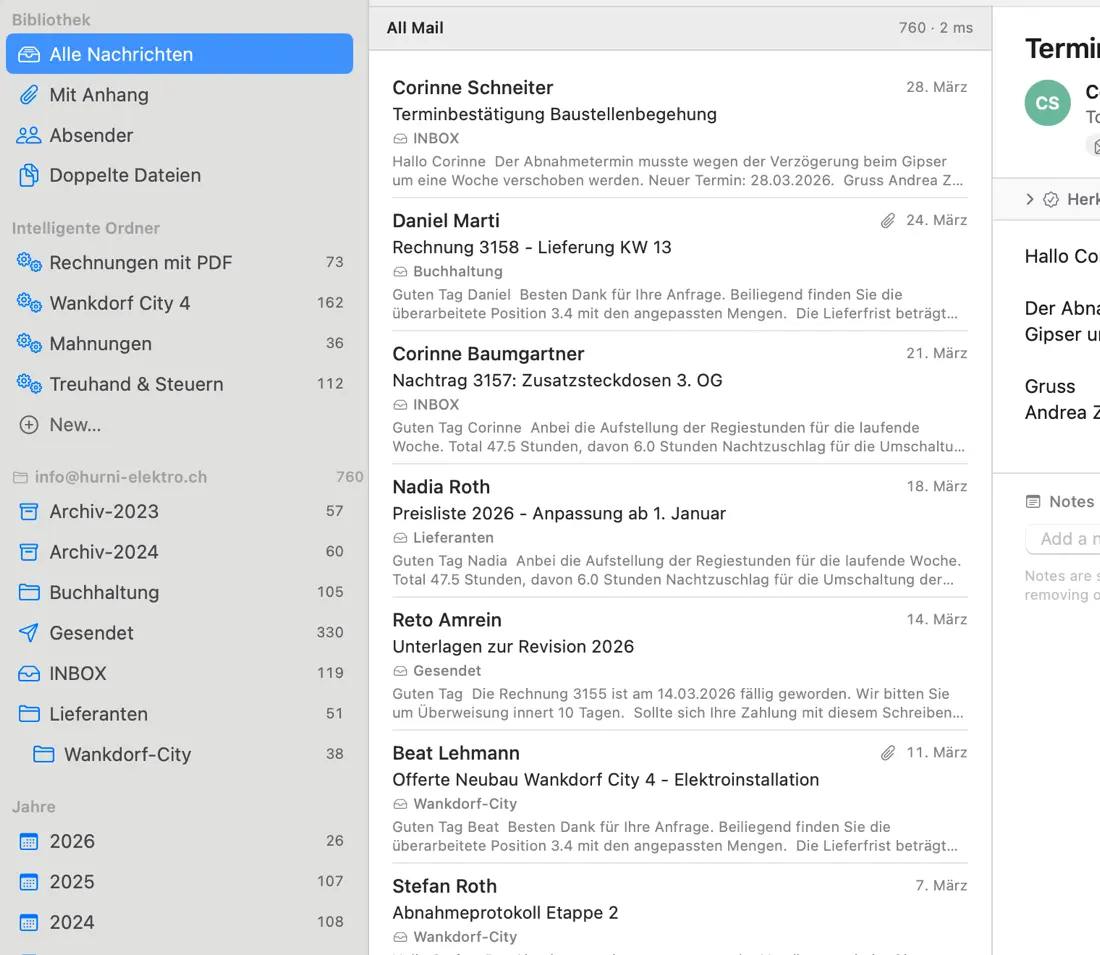
MailVault on macOS: mailboxes and smart folders of an archived account on the left, the message list in the middle, an opened message on the right.

One archive that satisfies four regimes at once. The effective period is always the longest one.

Switzerland

GeBüV / CO 957-958f

Ten years from the end of the business year, unalterable storage, proof of integrity.

Germany

GoBD / HGB 257 / AO 147

Unalterability, traceability, machine-readable export.

European Union

GDPR Art. 17

Selective erasure by destroying a key, without breaking the integrity proof.

United States

SEC 17a-4 / FINRA 4511

WORM storage, downloadable index, complete audit trail.

Interface and control report in German, English, French, Italian and Spanish. Further languages are in preparation and available on request.

Your mail server is not an archive.

A mailbox can be emptied, a folder moved, a message deleted. Change provider and what usually survives is an export nobody can open. And whoever has to show, eight years later, what was agreed on 14 March rarely still has the server it was agreed on.

Retention law does not ask you to have email lying around somewhere. It asks you to be able to show that nothing about it changed.

Records must be kept in such a way that they can be inspected and read at any time until the retention period has expired.

In substance, Swiss CO Art. 958f together with the GeBüV

What the software does

Archive it, prove it, find it, and hand it back.

Pull IMAP without touching the server

Mailboxes are opened with EXAMINE and read with BODY.PEEK. No message is marked as read, no flag is changed. The IMAP client refuses writing commands before a byte reaches the socket.

Import too, from mbox, Maildir, Apple Mail, Thunderbird, MH and loose EML files. The format is detected, not asked for.

61%

Stored size against the original in the demo archive shown here. Messages and attachments are identified by their SHA-256, stored once, and compressed individually.

Full text in milliseconds

SQLite FTS5 across subject, participants, attachment names and body. German umlauts and their ASCII spellings match each other, so Terminbestätigung also finds Terminbestaetigung.

Smart folders with real AND, OR and NOT

A saved search is a flat list. A smart folder is a tree: twenty-four fields, nesting four levels deep, with cached counts that are thrown away the moment the archive changes rather than trusted.

The MailVault sidebar with mailboxes, smart folders and years, each with the number of messages it holds.

Mailboxes, years, senders and smart folders, each with its count.

Hand it back, in any format

Export as EML, mbox, Maildir, or as a portable HTML archive that runs in a browser with no server and nothing installed. The export carries its index, journal and seals with it.

And back again: mailvault upload restores an archive to an IMAP server with its original mailboxes, flags and delivery times.

Nothing on the server changes.

That is a property of the client, not a promise. Unless the connection was opened for writing on purpose, and only the destination side of a migration ever is, the client rejects every writing command before it is sent.

Integrity

Three layers, so a change cannot pass unnoticed.

A hash-chained journal

Every action is recorded, and every entry carries the hash of the one before it. An entry changed or removed afterwards breaks the chain at exactly that point.

Ed25519 seals

At intervals the head of the chain is signed. The public key can be handed to an auditor separately, who can then verify the chain without this software.

Time from somewhere else

Each seal can carry an RFC 3161 token from a time-stamping authority. This machine's clock can be set backwards. A third party's signed statement cannot.

And the counter-check

verify --deep re-reads every message from storage, reassembles it from its parts, and compares it byte for byte against the digest taken at ingest.

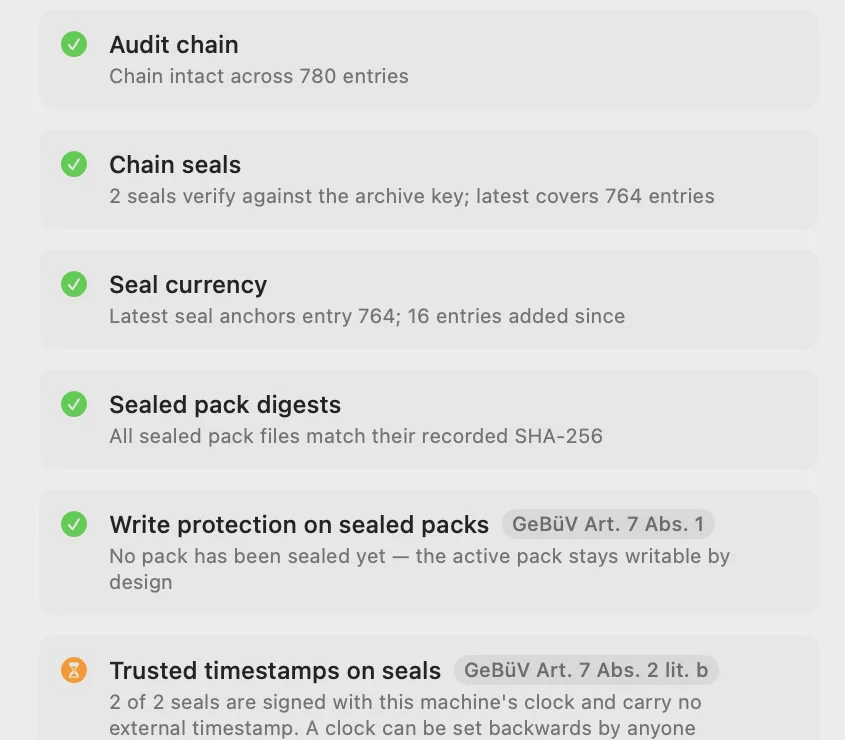
The check list in MailVault, with passed checks and one outstanding requirement about trusted timestamps.
An outstanding item is reported as outstanding, with the command that settles it. Not as passed.
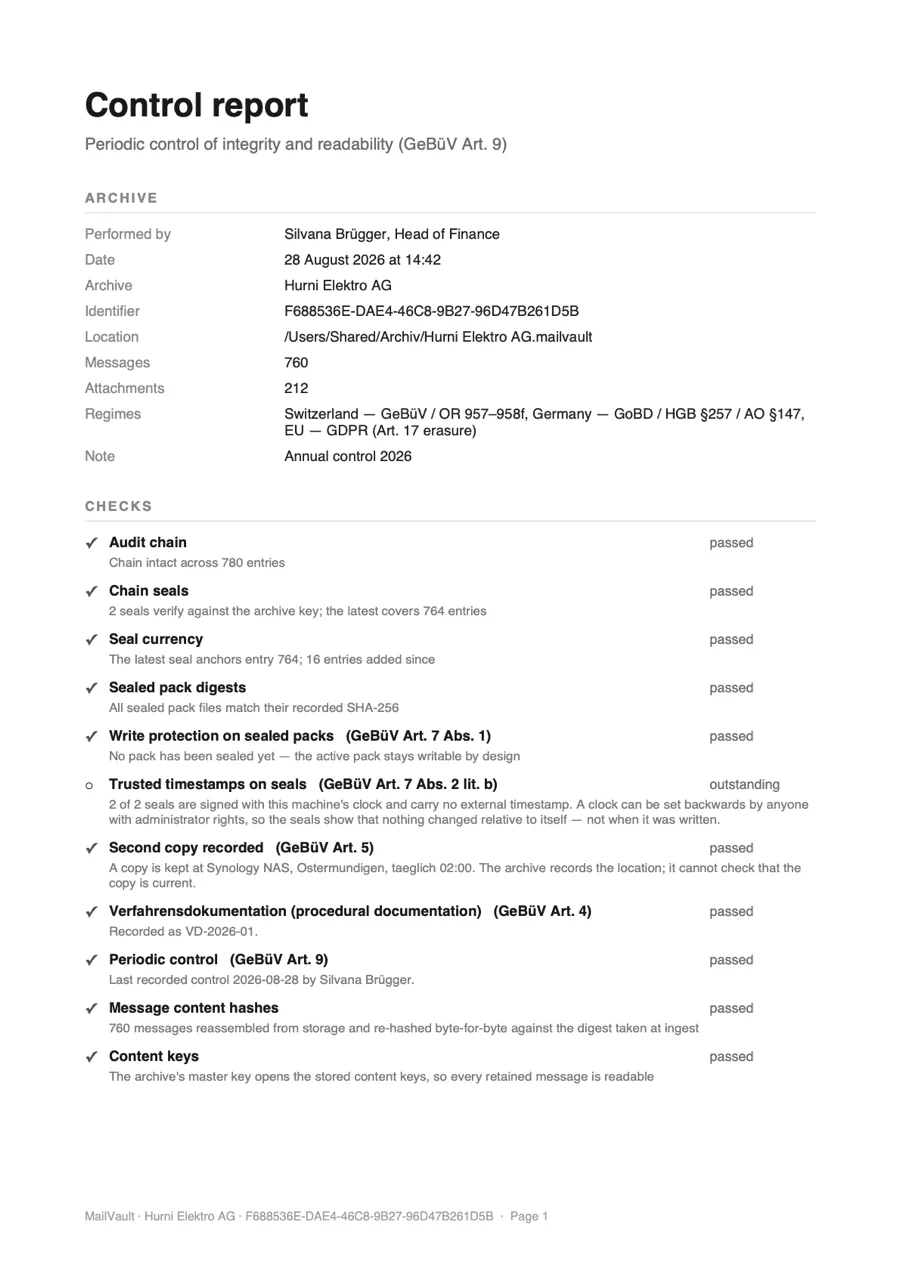
Page one of a control report: the archive's details, the checks with the provision each refers to, and an outstanding requirement.

The report somebody signs.

The GeBüV requires a periodic control. A control is a person looking, on a date, and putting their name to what they found. MailVault produces exactly that, as a dated PDF for signature.

  • A full deep verification runs before the report is written.
  • Every check names the provision it speaks to.
  • Outstanding organisational duties are listed, with the way to discharge them.
  • The PDF's own digest goes into the audit chain, so the signed copy can be tied back to it.
  • In five languages, whichever the reader needs. Checks, findings and outstanding items are translated too; statutory terms stay as they are.

Measured, not estimated.

23MB/s

Ingest on realistic business mail. Parsing, hashing and compression run on every core.

564MB

Peak memory importing 435 MB. It does not grow with the size of the archive.

377000

Messages in the test archive. Sidebar in 17 ms, switching mailbox in 14 ms.

1GiB

Per pack file. Each is sealed and checksummed as it is finished.

All figures taken on an Apple silicon Mac. Stored size depends heavily on the corpus: text compresses four to six fold, already-compressed attachments such as PDF or JPEG barely at all. For mixed business mail, expect 40 to 60 percent of the original.

In detail

What the archive actually does about each regime.

Several regimes can apply at once. The effective retention is always the longest.

Switzerland

GeBüV / CO 957-958f
Period
Ten years, counted from the end of the business year.
Unalterability
Finished pack files are locked against writing at the file system level.
Integrity
Hash chain and Ed25519 seals, optionally with an RFC 3161 timestamp.
Control
A dated, attributed control report under Art. 9.

Germany

GoBD / HGB 257 / AO 147
Unalterability
Content-addressed storage, every message identified by its SHA-256.
Traceability
A complete audit trail from ingest to export.
Evaluability
Export with index.csv and index.json beside the original files.
Procedural documentation
A template is included, with the technical part filled in.

European Union

GDPR Art. 17
Erasure
Each message body sits under its own AES-256-GCM key. What is destroyed is the key.
Why that way
The media is never rewritten, so the integrity proof survives the erasure.
Attachments
A shared attachment stays readable until the last message holding it is erased.
Subject access
mailvault request assembles everything about one person.

United States

SEC 17a-4 / FINRA 4511
WORM
Written once, read thereafter. No path in the program rewrites a sealed file.
Index
Downloadable and machine readable.
Duplicate copy
The location is recorded in the archive and reported in every check. Making the copy is your backup's job.
Holds
Legal holds override every retention period for as long as they stand.

What a program cannot do for you.

Part of what the law asks for is organisational. Where that is the case, MailVault reports the point as outstanding rather than showing it as met.

A second copy elsewhere

The location is recorded in the archive and named in every check. Making the copy, and keeping it current, is your backup regime.

GeBüV Art. 5

Procedural documentation

A template is included with the technical part filled in. Who does what in your organisation, and who deputises, only you can write.

GeBüV Art. 4

The periodic control

The verification runs on a button and the report is typeset. Looking at it and signing it has to be a person.

GeBüV Art. 9

A time-stamping authority

Every seal can carry an RFC 3161 token. Which authority should issue it is a decision for your organisation.

GeBüV Art. 7 para. 2

And nothing is ever deleted for you.

In no configuration. An elapsed retention period is permission to dispose, not an instruction. Disposing requires a reviewed list, a named approver, a recorded reason, and the confirmation typed by hand. Legal holds override all of it.

An archive that stays readable without us.

The portable export is a folder with an index.html. No server, nothing installed, no network. The page opens instantly whatever its size, because rows, search index and message bodies arrive only when they are needed.

For those who would rather look underneath: the format is documented. The catalog is ordinary SQLite, a pack record is twenty bytes of header plus a deflate stream, and the chain and seals can be recomputed with sha256sum and any Ed25519 implementation.

Export/
├── index.html the viewer, about 18 KB
├── data/ loaded on demand, never all at once
│   ├── meta.js dates, mailboxes, attachments
│   ├── rows-N.js list rows, 500 per shard
│   ├── idx-x.js search index, one shard per letter
│   └── body-N.js message text
├── messages/ the original EML files
├── attachments/ every attachment, once
└── reimport-manifest.json

Questions

Something still open? Write to us and you will get an assessment for your own mail estate.

Request a quote

Does archiving change anything on our mail server?

No. Mailboxes are opened with EXAMINE and read with BODY.PEEK, so nothing is marked as read and no flag is touched. The client refuses writing commands unless the connection was opened for writing on purpose, which only ever happens on the destination side of a migration.

Does MailVault delete email once the retention period ends?

Never on its own. There is no automatic or scheduled disposal in any configuration. The default reports expired messages and destroys nothing. Disposing requires that the list has been reviewed first, that an approver and a reason are recorded, and that the confirmation is typed by hand. Every message is checked again at the moment of disposal, so a hold placed since the review takes it off the list.

How do ten years of retention and the right to erasure fit together?

They collide less often than it looks. Where a statutory retention duty applies, it takes precedence over an erasure request. Where none applies, erasure has to be possible without destroying the proof for everything else. MailVault therefore seals every message body under its own key and destroys that key on erasure. The media is untouched, the chain stays verifiable, and the fact that an erasure happened is in the journal.

What happens if the database is damaged?

It is a derived index, not the record of truth. mailvault rebuild-catalog reconstructs it entirely from the pack files: messages, folder membership, flags, retention dates, the full-text index and legal holds. A test deletes the database outright and asserts that search results and every message digest come back identical.

Do we need an internet connection to read the archive?

No, and remote content in HTML mail is deliberately never fetched. Loading an image would tell the sender that a compliance archive was read and when, and would render the message as their server answers today rather than as it arrived. What is missing is named above the message instead of quietly absent.

Where does the data live?

On your Mac or your storage, in a single archive folder. There is no service behind it, no account, and nothing is transmitted to us. The database needs local storage, because SMB, NFS and AFP lock unreliably. Back that up to the network instead.

Can several accounts go into one archive?

Yes. Mailboxes are grouped by the account they came from, and the same message synced from two accounts is stored once and linked from both. An archive of up to roughly one million messages stays unremarkable to work in.

What about old mailboxes that no longer exist?

If an export survives, it can be imported: mbox, Maildir, Apple Mail, Thunderbird, MH or loose EML files. PST, OST, OLM and MSG are not read and have to be converted to an open format first.

Which languages does the software run in?

The interface and the control report both run in German, English, French, Italian and Spanish. It is not only the controls that are translated: the checks, their findings and the outstanding items in the report all appear in the chosen language. Statutory terms such as GeBüV Art. 9 or Verfahrensdokumentation are left standing as terms of art, because a translated citation cites nothing.

Further languages are in preparation and can be requested.

What does it require?

macOS 14 or later, on Apple silicon or Intel. For IMAP, an implicit TLS connection on port 993. A server offering only STARTTLS on port 143 is reported rather than silently downgraded.

We set the first archive up with you.

Tell us how many mailboxes you have and which regimes apply to you. You get an assessment of effort, storage and licensing.